Başak Layiç on Storytelling
Storytelling is as old as humanity itself—older even than theater. Tens of thousands of years ago, stories were one of our primary ways of passing on knowledge. And even now, in a world where information is available at lightning speed, stories remain essential. We spoke to a few of the Storytellers, who answered questions about their how's, where's and why's.
Where does the power of a story lie?
I believe a story has two legs: one is the teller, the other is the listener. And the power of a story comes from the connection between these two. As the storyteller, my job is to bring an authentic story to the table. By that, I don’t necessarily mean a "real" story, but one that resonates with the human condition. Something that feels emotionally true and allows the listener to recognize a part of themselves in it.
Does a story always have to be urgent, or can it be found in a small, simple detail?
Not necessarily. Hemingway has a famous six-word story: “For sale: baby shoes, never worn.” It’s just a few words, a simple image, but it’s heartbreaking. Sometimes a small detail is enough to open an entire emotional world.
Where do you find the stories you tell?
Usually, it starts with an image or a sentence that gets stuck in my head, like an annoying jingle you can’t get rid of. It keeps turning in my head until I have to pay attention to it. Then I test the idea first on my boyfriend or friends. And if I can get a chuckle or at least an eyebrow lift, I sit down to write.
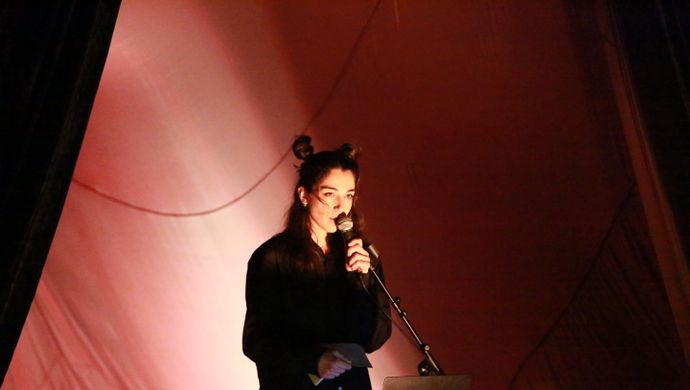
Başak Layiç performs Divine Madness on Friday the 10th of April.