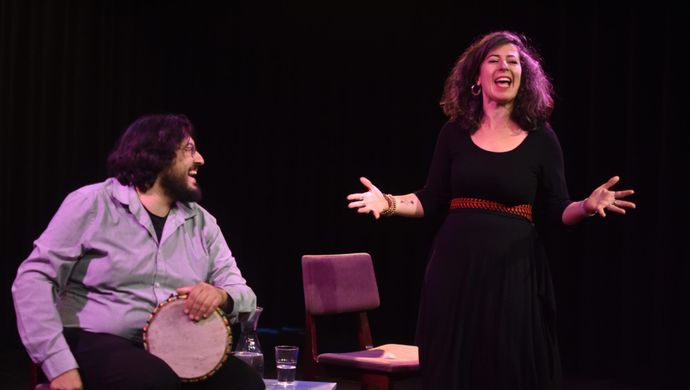
Sahand Sahebdivani and Rasha Hilwi on Storytelling
Storytelling is as old as humanity itself—older even than theater. Tens of thousands of years ago, stories were one of our primary ways of passing on knowledge. And even now, in a world where information is available at lightning speed, stories remain essential. We spoke to a few of the Storytellers, who answered questions about their how's, where's and why's.
Where does the power of a story lie?
As an Iranian and a Palestinian our lives are marked by chaos. Storytelling doesn't change any of this, but it sometimes makes sense of the madness. It offers a sense of hope and imagines a future that is kinder and less broken. It invites us to look at everything from perspectives we didn't consider in our day to day lives. It also invites the stories of two people, who might disagree on vital points, to weave their stories into something harmonious. An intimate process to which the audience is invited.
Does a story always have to be urgent, or can it be found in a small, simple detail?
Storytelling has the power to make the smallest detail feel urgent. There is a beautiful moment in a book by Milan Kundera. A grandmother sees an apple in an orchard. A ladybug flies and lands on the apple. In the far distance some tanks roll into the landscape. From her perspective the tanks are as small as the ladybug. It is also very tiring to only talk about the big urgent issues of the day. Storytelling can offer us a refuge from the big stories.
Where do you find the stories you tell?
As parents of small children (twins who are now turning five) we see life unfold in little tragedies and victories. Eating a plate can feel like a victory, having to go to sleep and not wanting to, a tragedy. When you look through the world through the eyes of one who has recently started observing it, you see stories everywhere. As two artists we take these small stories that don't feel small at all and add them to the absurd stories we experience as two migrants who deal with issues our neighbors don't have to deal with: what does life look like when through geography and history, we don't have access to our dead for a visit? How do we navigate the need to speak four languages in our small Amsterdam apartment, turning a shared breakfast into a UN meeting with translations? Stories come to us every day!
Rasha Hilwi & Sahand Sahebdivani perform A Trail of Pomegranate Seeds on Friday the 21st of April.